
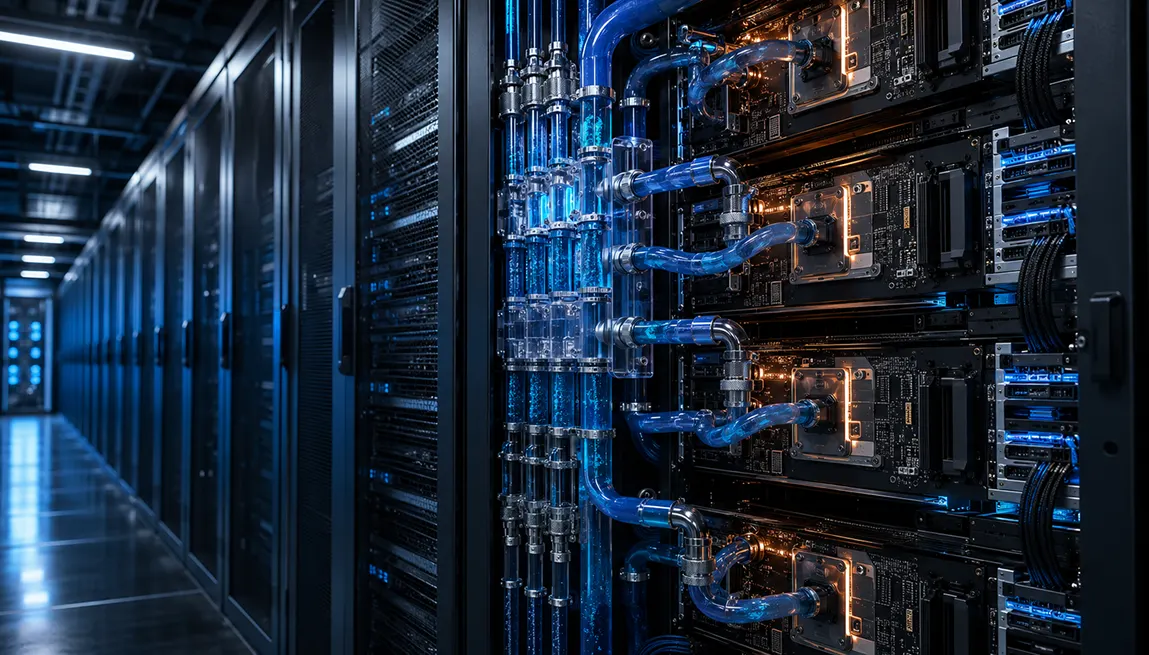
What happens when the world’s smartest computers start generating more heat than traditional cooling systems can handle?
That is the challenge many AI data centers face today. As artificial intelligence continues to grow, organisations are deploying powerful GPUs and high-performance computing systems to process massive volumes of data, train complex models, and deliver faster results.
However, this increase in computing power also brings a significant rise in heat generation, making conventional air cooling less effective in many environments. Liquid cooling has quickly become a practical way to manage these demands while supporting better performance and lower energy consumption.
In this blog, we’ll look at why liquid cooling is becoming a key part of AI data centers and HPC environments, the advantages it offers, and why it is shaping the future of modern computing infrastructure.
Why AI and HPC Generate More Heat Than Traditional Workloads
Artificial intelligence and high-performance computing (HPC) rely on GPUs and advanced processors that perform billions of calculations every second. Unlike standard business applications, these workloads operate at much higher power levels and often run continuously for extended periods.
As computing density increases, more servers are placed within the same rack, leading to significantly higher heat output. Air cooling systems, which have been widely used for decades, can only remove a limited amount of heat before they become inefficient. This creates temperature hotspots that affect server reliability and overall system performance.
To support growing computational demands without compromising hardware, organisations are increasingly adopting AI infrastructure cooling solutions that can efficiently manage these higher thermal loads.
What Is Liquid Cooling?
Liquid cooling is a method of transferring heat away from computer components using a liquid coolant instead of relying only on circulating air. Since liquids absorb and transport heat much more effectively than air, they provide faster and more consistent cooling.
Several liquid cooling technologies are commonly used in modern data centers, including
- Direct-to-chip cooling, where coolant flows through cold plates attached to processors.
- Rear-door heat exchangers that cool hot air before it enters the server room.
- Immersion cooling, where servers are placed in specially designed dielectric fluids.
Each approach is selected based on workload requirements, rack density, and facility design. Regardless of the method, the primary objective remains the same: maintaining safe operating temperatures while supporting maximum computing performance.
Why Air Cooling Alone Is No Longer Enough
For many years, air cooling served data centers well because server power requirements remained relatively moderate. However, AI clusters and HPC environments have changed those expectations.
Modern GPU servers often consume several times more power than traditional enterprise servers. As rack densities continue to increase, airflow alone cannot remove heat quickly enough. Cooling systems need to work harder, leading to higher electricity consumption and increased operating costs.
In many facilities, adding more air conditioning units only provides temporary relief while occupying valuable floor space. Liquid cooling addresses the root of the problem by removing heat directly from the source before it spreads throughout the data center.
This approach makes it easier to support high-density data center cooling requirements without major compromises in performance or scalability.
The Growing Role of Liquid Cooling in HPC Environments
High-performance computing has long depended on advanced cooling methods because scientific research, engineering simulations, weather forecasting, pharmaceutical development, and financial modelling require enormous computational power.
Today, AI workloads have joined these traditional HPC applications, creating even greater demand for efficient thermal management. Modern GPU clusters operate at power levels that conventional cooling systems were never designed to support.
As organisations expand research capabilities and deploy larger AI models, HPC liquid cooling has become a practical investment that supports both performance and long-term infrastructure planning.
Factors to Consider Before Adopting Liquid Cooling
Although liquid cooling offers several advantages, successful implementation requires careful planning.
Existing facility infrastructure should be evaluated to determine compatibility with liquid cooling systems. Factors such as rack configuration, plumbing requirements, maintenance procedures, and cooling distribution all play a role in selecting the most suitable approach.
Businesses should also consider future expansion plans. A cooling solution designed only for current workloads may become insufficient as AI deployments continue to grow. Building with scalability in mind allows organisations to accommodate increasing computing demands without significant redesign later.
Working with experienced infrastructure specialists helps businesses choose solutions that match both current operational needs and future growth objectives.
The Future of AI Data Centers
The rapid growth of artificial intelligence is reshaping the design of data centers worldwide. Processor performance continues to improve, GPU deployments continue to expand, and organisations are processing larger volumes of data than ever before.
Cooling technologies must evolve alongside these advancements. Liquid cooling is no longer viewed as a specialised solution reserved for supercomputers. It is steadily becoming a standard component of modern AI infrastructure because it supports greater efficiency, higher computing density, and more reliable system performance.
As businesses continue investing in AI, machine learning, and advanced analytics, facilities designed around effective thermal management will be better positioned to support future innovation.
How GoData Global Helps Build AI-Ready Data Center Infrastructure
As AI workloads continue to expand, businesses need data center solutions that can handle increasing computing demands without compromising performance or reliability. GoData Global helps organisations design and implement advanced infrastructure solutions that support AI, high-performance computing, and modern enterprise requirements.
With expertise in data center technologies, cloud solutions, and advanced computing environments, GoData Global helps businesses adopt efficient cooling strategies that align with their operational goals. From managing high-density workloads to improving infrastructure efficiency, the right technology approach can help organisations prepare for the next generation of computing.
Conclusion
Liquid cooling has become an important part of modern AI and HPC infrastructure because traditional cooling methods are reaching their practical limits. By removing heat more efficiently, it supports higher computing density, improves energy performance, and helps critical hardware operate more reliably.
As AI workloads continue to grow in size and complexity, investing in the right cooling strategy is no longer only about protecting equipment. It is also about creating an infrastructure that can support future expansion, deliver consistent performance, and meet the increasing demands of next-generation computing.
Power Your AI Infrastructure with GoData Global
Looking to build AI-ready data center infrastructure? GoData Global delivers advanced cooling, HPC, and data center solutions that help businesses achieve reliable performance, greater efficiency, and scalable growth for future computing demands.