
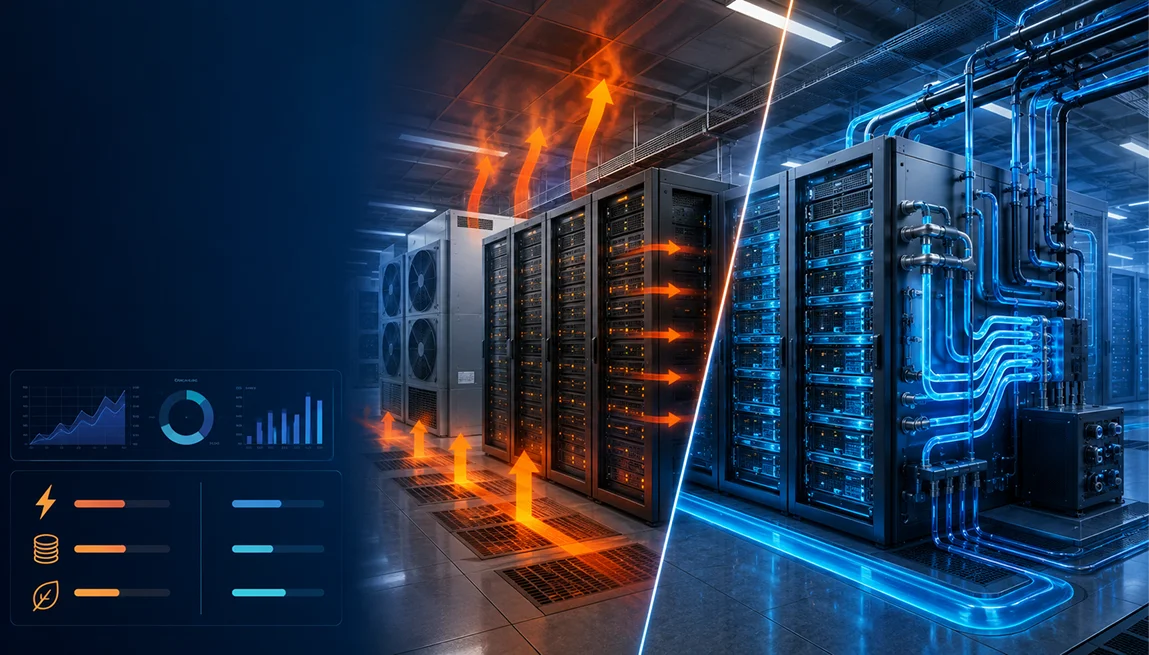
Air Cooling vs Liquid Cooling: The Real Cost Comparison in UAE

Air Cooling vs Liquid Cooling_ The Real Cost Comparison in UAE
Table of Contents
Summer in the UAE does not forgive poor planning. When outdoor temperatures push past 45°C, your server room’s cooling system stops being a background detail it becomes one of your biggest operational costs and one of your biggest risks.
For businesses managing on-premise infrastructure, edge deployments, or dedicated data rooms across Dubai and Abu Dhabi, the question comes up constantly: should we stick with air cooling or move to liquid cooling and what does either actually cost us?
At GoData Global, we help enterprises across the UAE make infrastructure decisions that hold up in the real world. Here is the honest breakdown.

Why Cooling Is a Bigger Problem Here Than Anywhere Else

Most cooling benchmarks you find online are based on temperate climates European facilities, North American data centres where ambient temperatures rarely exceed 35°C. The UAE operates in a different reality entirely, with summer peaks hitting 45–50°C and humidity adding further stress on conventional air systems. Energy-solutions

This matters because air cooling equipment works by expelling heat to the outside environment. The hotter it is outside, the harder the system works, the more energy it burns, and the faster components wear out. Liquid cooling, by contrast, transfers heat through a closed fluid loop making it far less sensitive to ambient temperature.
This single factor changes the cost equation entirely for UAE deployments.

Air Cooling: What You Are Actually Paying

Air cooling precision air conditioners, CRAC units, hot/cold aisle containment remains the most common setup in UAE server rooms and smaller data facilities. It is well-understood, locally supported, and straightforward to install.
Upfront investment: A properly designed air-cooled setup for a mid-sized server room handling 20–50 kW of IT load typically costs between AED 80,000 and AED 250,000, depending on unit capacity, redundancy, and containment design.

The ongoing cost is where things get painful. Energy efficiency in air-cooled facilities is measured by Power Usage Effectiveness (PUE) a ratio of total facility energy to IT equipment energy. A PUE of 1.0 is perfect efficiency. The global average annual PUE reported in 2022 was 1.55, and in UAE conditions, air-cooled facilities routinely land between 1.5 and 1.8 meaning for every 1 kW of server load, you are spending an additional 0.5 to 0.8 kW just keeping things cool. Eaton

In a country where commercial electricity tariffs are real and rising, that inefficiency compounds month after month.

Liquid Cooling: Higher Entry Cost, Lower Long-Term Burn

Liquid cooling whether rear-door heat exchangers, direct-to-chip systems, or full immersion moves heat away from hardware through a coolant loop. The physics are simply more efficient than pushing chilled air around a room.

Upfront investment: Expect AED 200,000 to AED 600,000 or more for a comparable setup, depending on technology type and density requirements. Immersion cooling sits at the higher end. Installation is more complex, and fewer than 300 liquid-cooling-certified engineers currently serve the entire GCC market, which affects both availability and cost of commissioning. Mordor Intelligence

The operational savings, however, are significant. PUE scores for liquid-cooled data centres consistently land below 1.2, compared to 1.4 1.6 for air-cooled facilities. Datacenters

RAt that rate, the additional capital investment in liquid cooling can pay back within two to four years in high-density environments and continue saving significantly beyond that.

The Maintenance Reality in UAE Conditions

Air cooling in the UAE means dealing with desert dust clogging filters faster than manufacturer schedules assume, compressors running at sustained high loads, and refrigerant checks that cannot be skipped. Maintenance costs here are genuinely higher than in cooler markets.
Liquid cooling reduces air-side components substantially, but introduces its own requirements: water quality management, leak detection systems, and coolant compatibility checks. These are manageable but they require either trained in-house staff or a managed services partner who knows what they are doing.
One factor many businesses overlook: air cooling components age faster under UAE thermal stress. Compressors and fans running at near-maximum capacity for months at a time have significantly shorter service lives than the same equipment in moderate climates. Liquid cooling systems simply do not carry this vulnerability.

So Which One Is Right for Your Environment?

Air cooling makes sense when your rack density stays below 10–15 kW per rack, your upfront budget is constrained, or you are in a leased facility where infrastructure modifications are limited.
Liquid cooling makes sense when you are running high-density compute GPU clusters, AI workloads, virtualised environments when you are building or refitting a dedicated server room, or when long-term operational cost reduction is a strategic priority.

The Dubai Universal Blueprint for Artificial Intelligence, unveiled in 2024, sets efficiency thresholds that are pushing data centre operators toward liquid-based solutions capable of maintaining PUE targets below 1.2 so for businesses with growth ambitions, regulatory direction is already pointing one way. Mordor Intelligence

There is no universal right answer but there is a right answer for your specific load, facility, and three-to-five year infrastructure plan.

At GoData Global, we assess your actual IT load, facility constraints, and growth roadmap before recommending a cooling strategy. We have helped organisations across the UAE avoid over-investing in cooling they do not need and under-investing in systems that cost far more in energy bills over time.

Ready to know what the right cooling decision looks like for your environment? Talk to a GoData Global infrastructure specialist clear advice, no jargon.

Godataglobal | Enquire now